Uber, Nvidia, and Scaling Urban Autonomy
March 24, 2026
Waymo deadlocks are the latest meme going around. It makes me think: what would happen when a Waymo, a Tesla, and a Waabi are stuck at the same intersection?
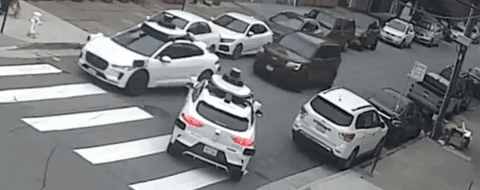
The current goal of applied autonomy is to make an individual robot operate safely in unpredictable environments.
This makes sense in the early stages of autonomy, but because things are changing quickly, it is easy to imagine how messy it can get when different fleets butt heads.
Waymo and Waabi often publish about scaling safely, but most of their writing assumes one operator per fleet. It soon becomes obvious that we will need a shared protocol that enables different fleets to coordinate with each other.
To stretch this point further, we need other companies to help Waymo, Waabi, and Tesla operate in the real world.
A useful framework to think this through is a layered autonomy stack that builds from an individual car all the way up to the network.
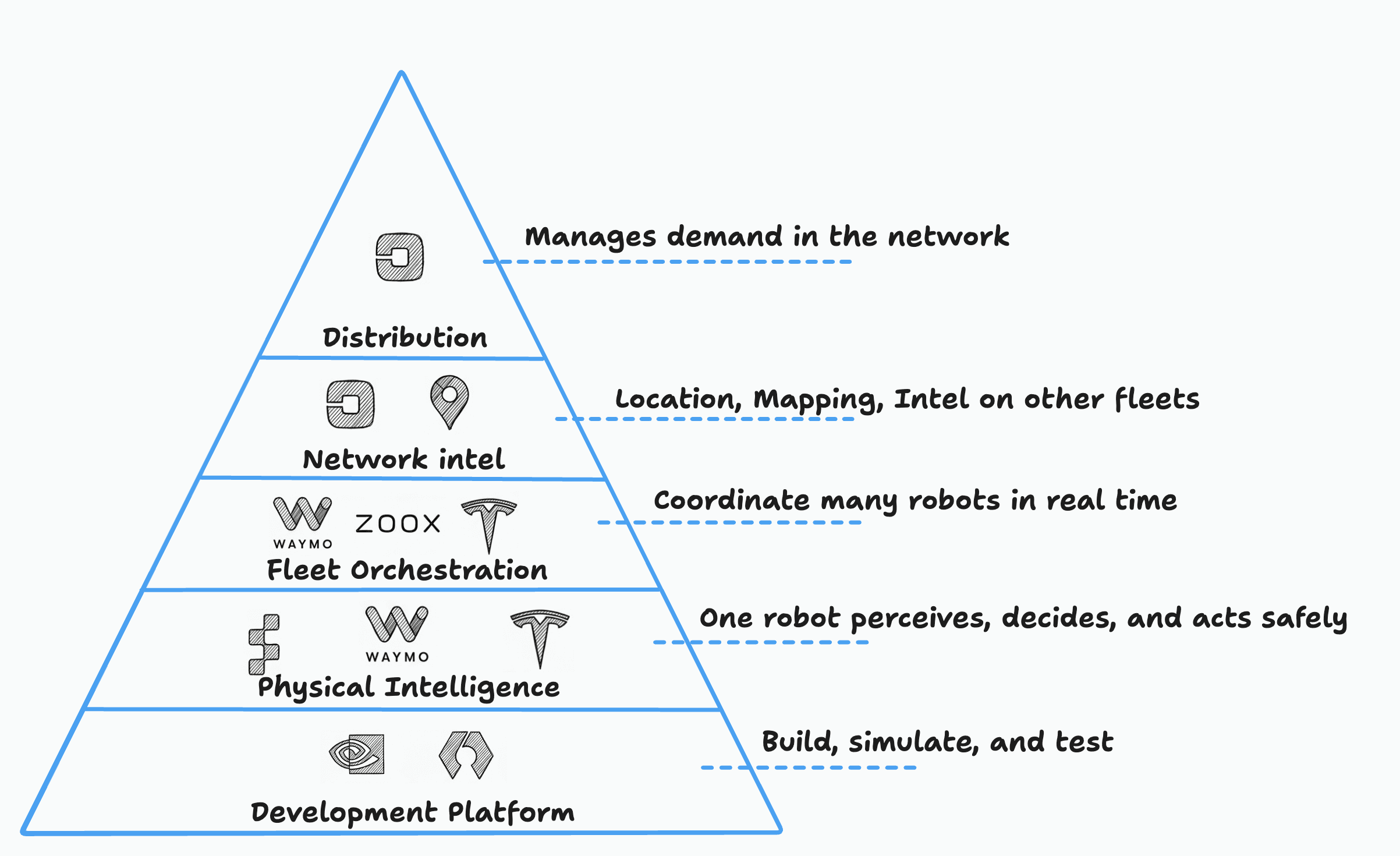
There is a lot of action in Physical Intelligence, but the middle of the stack – Network Intel and Fleet Orchestration – is under-discussed. I personally believe this is where Uber and NVIDIA can play a major role.
Many believe that Uber is asleep at the wheel when it comes to autonomy (no pun intended!).
In a recent article, Business Insider states:
...This is the very moment that true technologists with deep knowledge can make visionary bets on the future. Google and Tesla bravely stuck with AVs. They are now reaping the rewards by being many years ahead of the competition.
And Uber is left rushing to get back in the game...
Uber's core competency was never operating a fleet; instead, it was owning the network that a fleet operates on.
My hot take is that Uber becomes the infrastructure on top of which urban autonomy scales. There’s no other product that combines vehicles, maps, and network intelligence in a shared network at that scale. Uber had the luxury to let the AV market mature before entering it.
Back to the shared protocol problem: there is no company, other than NVIDIA, that currently offers a full stack of simulation tools and chips that allows different companies to model how their fleets would behave in shared environments.
If a Waymo and a Zoox approach the same tight intersection from different directions, neither fleet operator would have access to the other's planning system. They would still need to figure out who goes first. The coordination has to happen with minimal communication between different systems.
This is exactly the kind of problem researchers have been working on. This paper introduces an algorithm called MATP for resolving deadlocks between robots using only local communication. A simulation in a simpler environment looks something like this:

To validate something like MATP in a realistic environment, you need exactly the kind of simulation infrastructure NVIDIA is building. That is an entirely different business from selling chips.
In a recent interview with Stratechery, Jensen Huang said:
We realized that accelerated computing was a full stack problem, you have to understand the application to accelerate it…we're a technology stack…we're not a solutions manufacturer, we're not a service provider.
It is remarkable how everything NVIDIA does fits together and compounds its competitive advantage.
Uber provides the network. NVIDIA provides the environment where the network gets tested and validated. Neither of them needs to build a car to be essential in an autonomous world.
This will take a while to materialize, but Uber and Nvidia might end up shaping our future more than we give them credit for.